

The Renaissance of The Box Safety
Why Caleb Downs of Ohio State could be the most important non-QB draft pick of the decade.
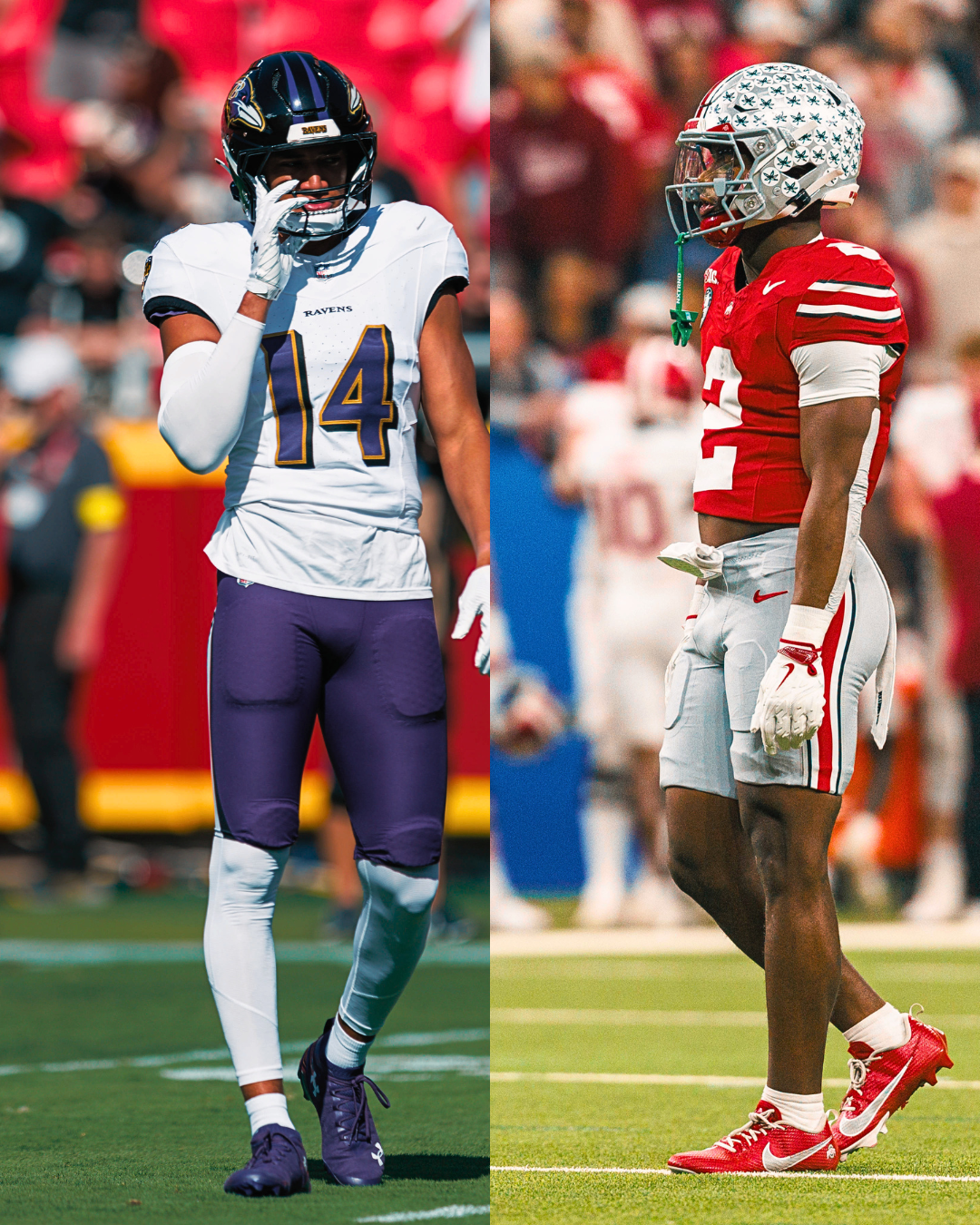
KANSAS CITY, MO - SEPTEMBER 28: Baltimore Ravens safety Kyle Hamilton (14) warms up prior to the game against the Kansas City Chiefs on September 28th, 2025 at Arrowhead Stadium in Kansas City, Missouri. (Photo by William Purnell Icon Sportswire)
December 06, 2025: Ohio State safety Caleb Downs (2) during NCAA, College League, USA football game action between the Indiana Hoosiers and the Ohio State Buckeyes at Lucas Oil Stadium in Indianapolis, Indiana. CSM Indianapolis United States of America
Ohio State safety Caleb Downs is widely regarded as not just one of the best defensive players in the draft, but is in the conversation for the best product the 2026 NFL Draft has to offer. His versatility is nightmarish for offenses to gameplan around, playing at least 20% of his snaps in 3 different listed defensive positions in 2025 (20.2% Slot Corner, 30.8% Box Safety, 35.3% Free Safety). Downs is the latest addition to a new but growing list of hybrid safety prototypes, a progression of the position that has taken over the NFL in the past 4-5 years. But where exactly did this advancement of safety play come from? For so long, the traditional Free Safety and Strong Safety stayed separated in their respective roles, and on very few occasions would the job of one intentionally be placed into the lap of the other. But since the dawn of the 2020s decade, teams have invested more into more dynamic play that expands the role and adds depth to a position often commonly seen as “the last line of defense”. But before looking at the revolution, we have to start with the founding fathers, the ones who paved the way for safeties in the NFL to simply matter more.
All Roads Lead Back to Seattle:
Almost every philosophy of defensive back play can be traced to the infamous Legion of Boom, with today’s focus being the hard-hitting monster Kam Chancellor. If the Legion of Boom were superheroes, Chancellor would without a doubt be the Hulk, terrorizing offenses with legal contact that would make you reconsider even playing football. A large part of what made the Legion of Boom so successful that doesn’t get talked about as much as it should, is the mastermind Dan Quinn marrying a 4-3 front while primarily sitting in cover 3, putting a lot on the shoulders of DBs in tight space but also providing a fair enough pass rush to assist them on most downs. In 2013, the peak of Seattle’s dominance over the league, Kam Chancellor played a total of 1,363 snaps, with 500 of those coming from the box, 490 from the free safety position, and 191 out of the nickel position. It was Earl Thomas who earned 1st Team All Pro Honors that season, but Chancellor was the motor of that Seattle defense, as the role of being able to rotate coverages and kill plays from one end of the field to the other was played perfectly by him. His versatility continued into the following seasons but the physical toll caught up to him, as a spinal stenosis injury in a 2017 game against the Arizona Cardinals put him out for the rest of the season, and following failed physicals that pointed to the risk of paralysis, Chancellor was left with no choice but to walk away from the game altogether, at just 29 years of age. Chancellor was harsh evidence of the high risk high reward that was tied to having a player as versatile as him, and for many teams, the risk outweighed the contrary. In order for the position to evolve into what it is today, there had to be a sense of insurance to build continuity, but not long after the reign of Chancellor, his torch would be picked up by another monster in the NFC.
The Understated Impact of Harrison Smith:
Many will remember Harrison Smith for his sheer skill at the safety position, but few will see him as a pioneer of the box safety position. Smith was the first high caliber box safety of the 2010s and onward era to perform through versatility for an extended, well decorated career, proving wrong the contrary fear of health at the position by limiting his physicality into specific scenarios where it would be needed more. Smith’s step back on recklessness was a step forward for longevity, and in his 7 seasons of splitting snaps both in the box and at the free safety position, he opened the door for the position to truly evolve in commonality and long term value. But what did he do differently than guys from the past like Kam Chancellor or Bob Sanders? The answer lies in fluidity. During training camp in 2025, going into his 14th season, Smith gave his recipe for success in an interview with Dave Campbell, of WCCO Minnesota.
“All the strength work in the world isn’t really going to translate to real strength on the field if your joints don’t have the range they once did, especially range under load,” Smith said. “I’ve come up with different ways to work out that aren’t necessarily just the traditional banging weights around. I'm not saying there’s anything wrong with that, but if you don’t have your range ready, it’s kind of almost counterproductive.”
The answer for longevity at such a physically demanding positionless position was bringing in fluidity to lighten the toll that each hit takes on the body. Leading with brute force is impactful but short-lived. Marrying force and flow is what extends your influence on the game, and Smith realizing this shifted his focus in physical training to extending the fluid possibilities of his arms, thus reducing the risky scenarios that leave his body vulnerable and leading to the parallel to the extensive play of his career. The emphasis of such an important factor revolutionized box safeties, and brought a new idea of just how valuable an elite guy at that spot could be, especially for an extended period of time. The only ‘issue’ for lack of better term with Smith’s legacy at his said position was the fact that a lot of opportunity for him to play in multiple spots was left on the table, as he didn’t start seeing significant snaps in the box until 2016, his 5th season in the NFL after playing traditional free safety the 4 years before. So with the proper formula for success out the bag, what if there was a guy who was able to apply it immediately into entering the league? To have such a level of influence on a defense at a young age would signify for that player’s team to build around him, not with him. But in the 2022 NFL Draft, the final project arrived, and in just 4 seasons, he has already written his name in the book of the elites.
Kyle Hamilton
With the 14th pick in the 2022 NFL Draft, the Baltimore Ravens didn’t just select Kyle Hamilton, they brought in a cornerstone for the evolution of defensive football. While it took time for him to become the All-Pro he is now, the difference in Baltimore’s defense with Hamilton on the field vs off is night and day. At 6 '4, 220 LBs, Hamilton brought a physique that was later molded into the ultimate swiss army knife, a large part due to at the time Ravens defensive coordinator Mike MacDonald. During his rookie season in 2022, Hamilton played 354 of his 600 defensive snaps as a nickel-back, roughly 59% of the time he saw on the field as a defender. And while he had a good rookie campaign, it just felt like something was missing. Hamilton’s senior year at Notre Dame saw tense levels of versatility which is what got him to the draft position he ended up at in the first place; taking that away and using him in an expendable manner felt underwhelming, so before the 2023 season the Ravens traded former starting safety Chuck Clark to the New York Jets, opening the door for MacDonald made the change, and Hamilton to make the leap into what got him in the NFL to begin with. From that point on, his percentage splits as a box safety, slot corner, and free safety according to PFF went 22/43/28 in 2023, 35/25/30 in 2024, and 35/29/16 in 2025, with an additional 16% on the defensive line.
Hamilton’s impact is so great its become non-negotiable. Even when he IS on the field but playing a traditional DB position, the Ravens defense lacks that missile who can take command of an entire defense, and as seen during a 4 game stretch in 2024 where Kyle Hamilton only played primarily in the box, the Ravens defense during that stretch allowed 32.25 points per game, as opposed to 19.9 points per game when Hamilton was given a fair split of roles in the other 13 games. The trend of his impact has stretched to other safeties in the NFL, with names such as Brian Branch, Grant Delpit, and Nick Emmanwori taking the league by storm; and while talent has always been a standout factor within the box safety position, the later addition of usage, statistical impact, and longevity is only just beginning to take football by storm.
Who’s Next in Line?
The want, let alone need for dynamic safeties in the NFL has skyrocketed over the last 2-3 seasons, and Ohio State prospect Caleb Downs hits the checkbox and some for those who are in the market to 180 their defense. What makes him so special is not just his versatility, but his natural defensive back movements, showcasing high levels of ball tracking, hip movement, and contesting the catch point; the things of an elite corner. With the help of coaching and the freedom to float around the field, he will no doubt host an immediate impact both for the team he plays for and the ones he plays against. Downs is next in line for a movement and his success is vital, as another high caliber dynamic safety could see the luxury of a 2-way safety slowly turn into a common possession for most teams, eventually modifying popular coverages that are based on the skillset of the safety, such as big nickel and quarters formations. With the individual success of guys like Harrison Smith or Kyle Hamilton, and the impact Nick Emmanwori had on a Super Bowl winning team that was primarily defensive, a 4th swiss army knife with instant impact won’t just change his team, it’ll flip around the league. The NFL has taken multiple steps forward offensively with notable masterminds dominating the league with their philosophies and techniques, such as Sean McVay reinventing the play action pass on a Steph Curry level of influence, or Ben Johnson hyperfocusing on his players’ strengths and building systems of weapons through those like he did in Detroit and is in Chicago. Football as a whole has seen plenty of philosophical offensive regime changes in football, and the success of Caleb Downs could very well be the nail in the coffin to a defensive revolution to even out the playing field. While its unlikely he goes 1st overall due to the Raiders pending quarterback needs, a safer bet would be his play on the field resembling that, and if all goes well, we’re looking at a completely new ballgame in the sense of how defensive back play will evolve.