

Nothing To Defend: How Mike Macdonald is dealing with his post Super Bowl Season
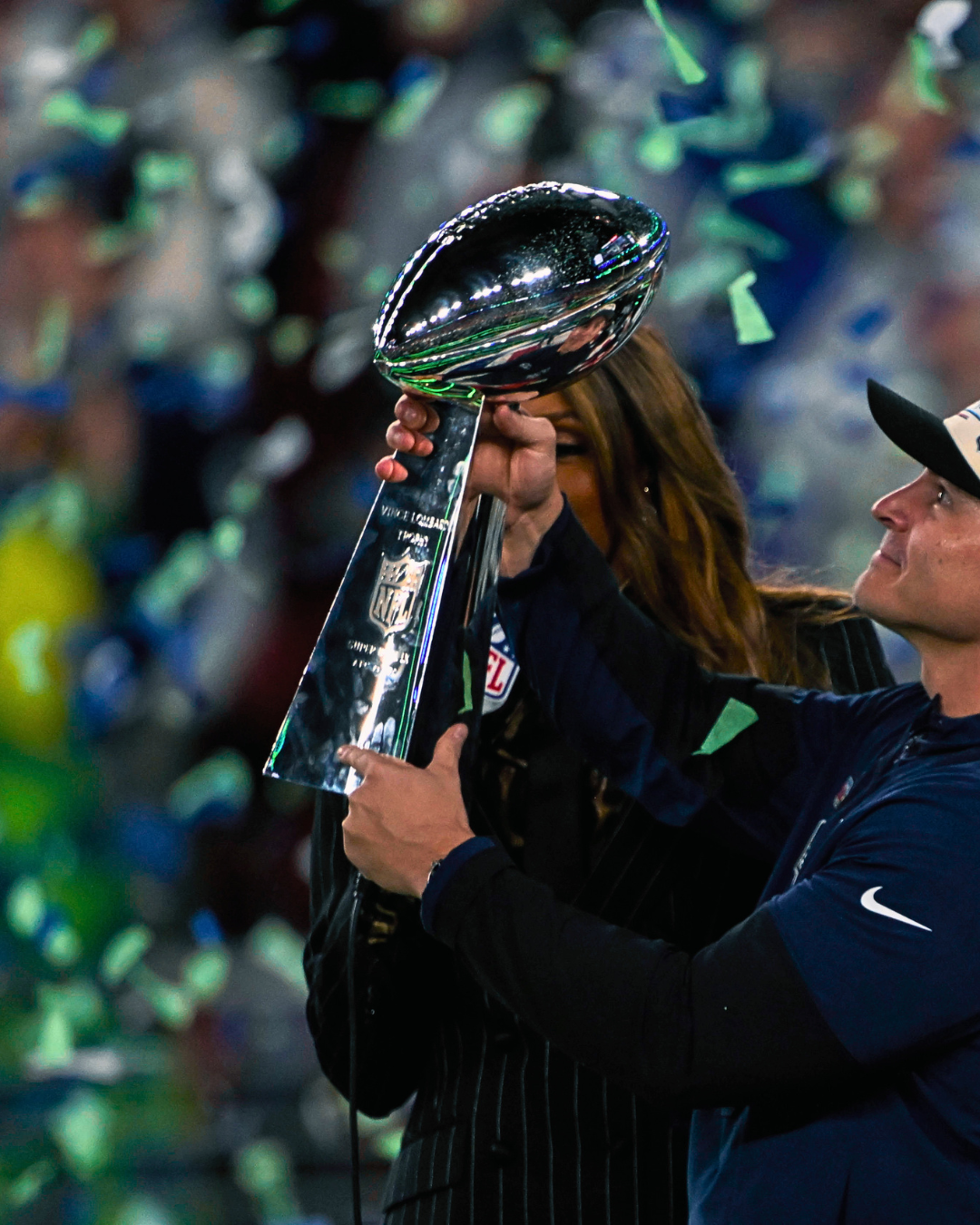
February 08, 2026 Seattle Seahawks head coach Mike MacDonald celebrates with the Vince Lombardi trophy after winning Super Bowl 60 in Santa Clara, California. Mandatory Photo Credit : CSM Santa Clara United States of America
A championship changes a team’s expectations immediately. Seattle was nowhere near the favorite to win it all when last season began. Even after its Super Bowl victory in February, skepticism remained, with perceived flaws becoming reasons to dismiss the championship as a fluke.
For Mike Macdonald, that conversation comes with a question Seattle’s Super Bowl banner cannot answer: How much of what made the Seahawks champions can survive when the team itself changes?
“We’re not defending anything,” Macdonald said at the NFL annual meeting in March.
The statement can sound unusual coming from the coach of the defending Super Bowl champions. But it gets to the center of his approach. Seattle can carry its standard into another season. It cannot carry last season’s results with it.
Three games into 2026, the Seahawks are 2-1, coming off a 33-31 loss at Washington. Macdonald has already navigated a new offensive coordinator, significant free-agent departures and injuries at quarterback and safety. The question is whether his decisions are giving Seattle a way to succeed through those changes.
The Seahawks did not lose their entire championship foundation. They did, however, lose several players who helped hold it together.
Kenneth Walker III left for Kansas City. Coby Bryant signed with Chicago, Boye Mafe with Cincinnati and Riq Woolen with Philadelphia. Walker and Bryant started Super Bowl LX, while Mafe and Woolen played significant defensive roles.
Those departures affect different parts of the same operation. Walker’s absence changes the backfield. Losing Mafe changes the edge rotation. Bryant and Woolen’s departures change the options in the secondary. Replacing their roster spots is one task. Replacing the combinations of experience and ability available on a particular down is another.
The coaching staff experienced its own transition. Offensive coordinator Klint Kubiak became the Raiders’ head coach, leaving Macdonald to decide how much of Seattle’s offensive identity to preserve.
Hiring Brian Fleury, who shared a San Francisco coaching background with Kubiak, offered a path toward continuity. At his introductory news conference in February, Fleury said the goal was to “maintain as much of that as possible.”
Familiar concepts can ease a transition, but they do not guarantee an identical offense. The new coordinator still has to establish trust, make decisions and find answers during games.
Macdonald’s responsibility extends beyond designing the defense. It includes creating the conditions for someone else to lead the offense.
Macdonald’s reputation as a defensive strategist can make it easy to assume Seattle’s success comes from continually adding complexity. The championship season showed another strength: his willingness to rely on what his players did well.
An Oct. 29, 2025, report citing NFL Next Gen Stats showed Seattle used four-man rushes on 79% of opposing dropbacks, the third-highest rate in the league at that point. Its pressure rate with four rushers was 36.1%, fifth in the NFL. The Seahawks blitzed on 19% of dropbacks, the third-lowest rate, but generated pressure on 51.7% of those blitzes, third in the league.
Those figures are an in-season snapshot from 2025, rather than current rates or final championship-season totals. They show how Seattle’s personnel supported its playcalling. The Seahawks could pressure quarterbacks with four rushers while keeping more defenders in coverage. They also used dime personnel at a 16.5% rate, trusting smaller packages to hold up against the run. When Seattle sent extra pressure, it was effective.
That approach will not necessarily work with every lineup. Evaluating Macdonald requires more than counting how often he blitzes. The more useful question is whether his pressure plan fits the players available and the opponent in front of them.
The 2026 win at Arizona provides a more recent example. In his Sept. 21 Hawk Blogger analysis, Brian Nemhauser reported that Seattle blitzed on 4.7% of the Cardinals’ first-half dropbacks, then on 50% after halftime. Arizona finished the second half with just 16 net passing yards and 44 total yards.
That contrast shows Macdonald’s flexibility. He began by sending fewer extra rushers, then became considerably more aggressive. The numbers alone cannot explain everything behind Arizona’s struggles, but they show a clear adjustment within the game. Seattle’s success without frequent blitzing did not keep Macdonald from sending extra rushers when he saw an opportunity.
Nemhauser’s Sept. 28 review added another useful distinction. Citing SumerSports data through three weeks, he reported that Seattle ranked fourth in quick-pressure rate at 23.1%, measuring pressures arriving in less than 2.5 seconds. Its average time to pressure, 2.45 seconds, was tied with Kansas City for the fastest in the league.
Those measures describe how quickly pressure arrives, rather than how consistently Seattle generates it. That distinction helps explain how strong season numbers can coexist with Macdonald’s dissatisfaction after Washington. The task is to turn that ability into disruption when the game demands it.
Maintaining that flexibility became more complicated before the regular season began. Rookie safety Bud Clark broke his ankle in the preseason game at Tennessee, removing a potential contributor from an already changing secondary. Macdonald said Clark would be out for multiple months.
By Week 3, the problem had expanded. Ty Okada missed his third consecutive game with a hamstring injury, and Julian Love was ruled out after injuring his calf in practice. Seattle prepared to start AJ Finley alongside Rodney Thomas II against Washington.
For a defense, depth means more than having enough players to line up. It determines which combinations a coach trusts, how players communicate responsibilities and how much flexibility remains when an opponent forces an adjustment.
The offense faced an early disruption of its own. Sam Darnold started the opener against New England before leaving with what was later identified as a glute injury. He missed the Week 2 win at Arizona and returned for Week 3.
Fleury’s first regular-season game as Seattle’s playcaller became an immediate test of the staff’s preparation when Drew Lock took over against the Patriots. Afterward, Macdonald praised the offense’s composure.
“We still liked our plan,” he said.
That confidence mattered because the staff still had to make the plan work with a different quarterback. The coaches had to adjust, the backups had to be ready, and the players had to trust the decisions being made around them.
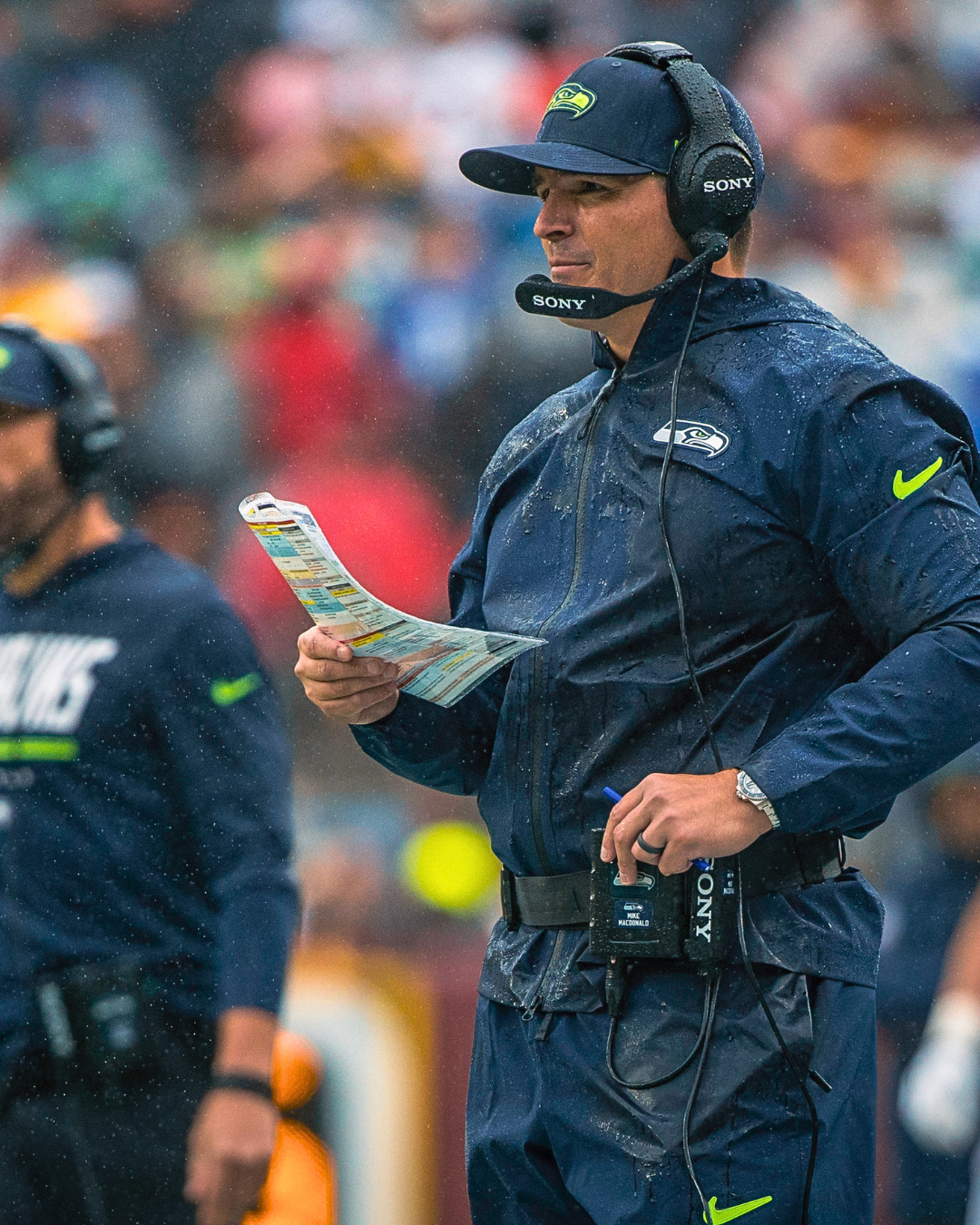
September 27, 2026: Seattle Seahawks head coach Mike MacDonald during the game between the Seattle Seahawks and the Washington Commanders played in Landover, Maryland.
Washington provided a different test. Seattle lost the turnover battle 3-0. The Commanders scored a defensive touchdown and benefited from short fields, making the final score an incomplete picture of the Seahawks’ defensive performance. Washington averaged 4 yards per play and converted three of 13 third downs.
But two of those conversions came when Seattle most needed a stop.
On Washington’s final possession, an outside run converted third-and-9 after Seattle showed pressure and failed to set the edge. Marcus Mariota then ran for another first down on third-and-7, denying the Seahawks a final opportunity.
“We didn’t get enough pressure today,” Macdonald said after the game.
The loss showed the limits of treating a defensive identity as a guarantee. A team can produce strong overall numbers and still lose the moments that decide a game. Macdonald deserves credit for a defense capable of keeping Seattle competitive through changing circumstances. He also bears responsibility for finding answers when an opponent beats its calls.
On Monday, he described the loss as a learning opportunity and said he could “feel the resolve” in his players.
That response fits his broader approach. The next measure is whether the corrections become visible on the field.
Macdonald’s public handling of an off-field controversy offered another view of that responsibility.
An interview with Graham Bensinger included Macdonald’s account of a 2024 dispute with Sean Payton over Seattle scouting Broncos training camp plays through videos fans posted online. Macdonald said he had not intended his comments for public use and called Payton to apologize. Payton said the two coaches had resolved the matter.
“I’m responsible for what I say,” Macdonald said.
The circumstances were different, but the response reflected the same willingness to take ownership. Explaining what happened did not remove his responsibility for it.
Macdonald has approached the opening stretch after Seattle’s championship by treating continuity as something to build rather than something to assume. Familiar concepts, returning players and an established standard give the Seahawks a foundation. Making those pieces work with a changed roster is the challenge.
Washington showed why the assessment must remain measured. Preparation and resilience do not eliminate turnovers, unsuccessful calls or missed opportunities. Three games cannot establish that Seattle has solved the challenge of following a championship.
They can, however, establish the right question to ask. The Seahawks do not need every new player to recreate the season of the player he replaced. They need the current roster to function together well enough to meet the standard that remains.
Macdonald has made that standard clear. Turning it into another successful season is the work still in front of him.
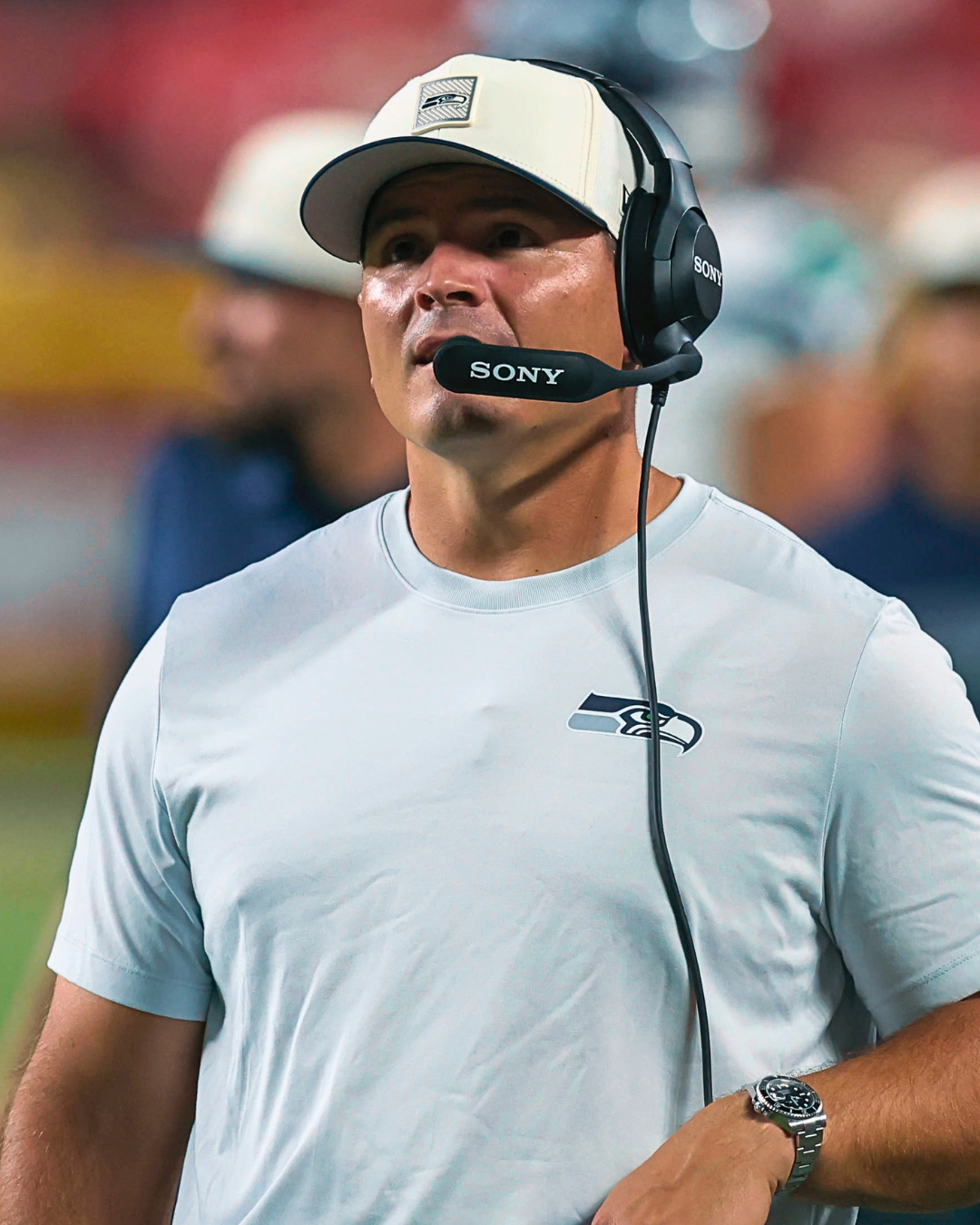
KANSAS CITY, MO - AUGUST 28: Mike MacDonald of the Seattle Seahawks during an NFL, American Football Herren, USA preseason game between the Seattle Seahawks and Kansas City Chiefs on Aug 28, 2026 at Arrowhead Stadium in Kansas City, MO. (Photo by Scott Winters Icon Sportswire)
