

Evaluating Struggling Quarterbacks
With a month of regular season football behind us, we’ve seen many unexpected signal callers produce at a rate that places them at the top of the league, as well as many fan favorites and household names continuing to do what they do best. But what’s equally as eye popping, is the amount of promising quarterbacks that have fallen short of expectations or development so far this season.
The quarterback position is of course very nuanced, and requires attention to detail when evaluating. But after 12 quarters of football, its fair to say that many who came into the season with high expectations or a criteria of development to meet just haven’t met that bar yet. Of course, its very early in the season, so to write off any quarterback as a whole would simply be wrong. But better to see the cracks now than later.
Justin Herbert
Herbert’s 2025 was an efficient season, but with the addition of well known offensive mind Mike McDaniel, the perfect storm for Justin Herbert to return to field general form was brewing; or at least supposedly.
In 3 games this season, Justin Herbert has mustered 627 passing yards, a 3:4 TD:INT Ratio, 7 turnover worthy plays, -0.18 EPA Per Play, and a 73.4 passer rating. The Chargers find themselves at 0-3, following an ugly 24-16 loss to the Bills last Sunday.
What makes discourse surrounding Herbert so interesting, is the strong dynamic opinions on both ends of things, largely due to conversations about the ecosystem around him. We know how talented and how much of a physical specimen he is, we also know how problematic the Chargers organization is and the weight they put on their QBs, a theme that dates back to Philip Rivers. However the decision making you’d expect out of a high caliber QB going into year 7 has been lackluster, which brings a heavy price with it.
In Herbert’s defense, yes; the Chargers entire offense has been quite disappointing this year. According to PFF grades, the pass protection ranks 27th in the league, receiving grades 30th, and the running game 23rd. As a collective whole they have 2 runs of over 15 yards the entire season, 4 drops, and 46 pressures allowed.
But those same metrics can be used to pinpoint where Justin Herbert himself has been as equal of a liability to the Chargers. The only quarterbacks with more turnover worthy plays than Justin Herbert this year are Drake Maye and Bo Nix, responsible for 25% of the Chargers pressures allowed, T-4th in unnecessary sacks taken, 27th in clean pocket passer rating, and 32nd in success rate.
Not to ramble on a laundry list of metrics, but we’ve seen multiple elite or even great QBs sit in awful situations; Jayden Daniels as a rookie was pressured on a similar rate and thrived in Washington. But the numbers in a clean pocket are just as frightening and Herbert’s stagnation in the pocket has led to many careless decisions.
Another disappointment tied to Herbert’s lack of success is Mike McDaniel and his inability to place receivers in favorable positions to counter the amount of pressure Herbert faces. In 2021 a season that saw Herbert eclipse 5,000 passing yards and one that many consider his peak, the Chargers receivers and tight ends average depth of target was 9.03, allowing for intermediate connections and opportunities for plays to be made in the slot with the advantage of an automatic mismatch. Fast forward to 2026, and that number jumps up to 13.9, making it impossible for Herbert to get the ball out quicker.
Drake Maye
Its been a rough 3 weeks for last year’s MVP runner-up. With 9 turnover worthy plays in the first 3 weeks of the season, its not a stretch to say he just looks lost out there. The turnovers were an underlying issue in New England’s postseason run a season ago, and the issues have spilled over into this current season, playing a massive effect in the Patriots’ 1-2 start.
One thing that stood out about Drake Maye’s stellar 2025 season was the deep ball. On throws 20+ yards downfield, Maye finished the regular season with a 132.7 passer rating, a 9:1 TD:INT ratio, and a 98.6 PFF grade. To play into this strength, the Patriots traded for All-Pro receiver AJ Brown, to provide Maye with a well renowned vertical threat.
However in Week 1 against Seattle in a Super Bowl rematch, Brown suffered a high ankle sprain. The injury put him on injured reserve and sidelined him until midseason, robbing Maye of the weapon New England wanted for him so badly. Without Brown, the deep ball hasn’t just taken a step down, its been downright awful. On 98 qualified dropbacks in 3 weeks that ended in passes 20+ yards downfield, Maye has completed under 40% of these, with no touchdowns, 4 interceptions, and a 46.6 passer rating.
The Patriots are preparing for a matchup with the Buffalo Bills on Sunday, whose pass defense has been among the worst in the entire league. An early opportunity at a “Get Right Game” lies ahead of Drake Maye, but a looming cloud of doubt surrounding the QB floats in the air as well
Cam Ward
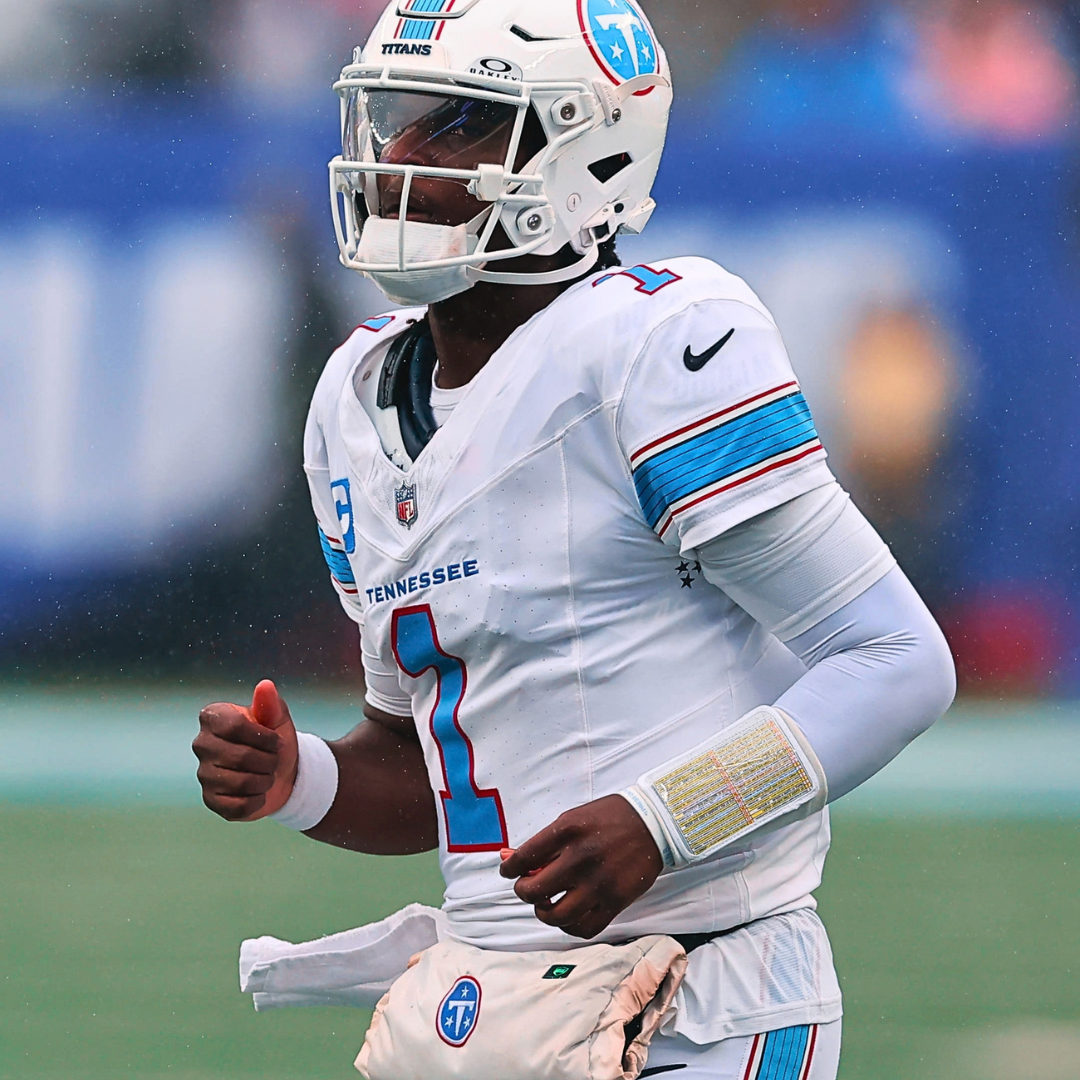
Narratives surrounding Cam Ward in 2025 were protective of the rookie, and rightfully so to an extent. It was well known that his supporting cast was one of the worst in football and no other QB arguably had it as bad as Ward, especially considering the strength of the AFC South last season. He was labeled a ‘Diamond in the Rough’ and the expectation for 2026 was that with a slightly better team around him, he would continue to develop into a potential franchise QB for the Titans.
But 2026 has looked more of the same, if not worse for Cam Ward
Of course, the Titans ecosystem wasn’t going to change overnight. Ward is still pressured at a moderate rate and the Titans receivers don’t consistently create ideal separation. But the poor decisions made in the pocket fall on his shoulders. Ward is raw as an athlete but his uphill battle with accuracy and ball placement often gets overlooked due to how poor his supporting cast is. As great of a prototype as he is, it feels like ‘the basics’ are what holds him back
To clarify, there is no reason to give up on Cam Ward or believe, especially in today’s NFL where the Jared Goffs and Baker Mayfields of this world can revive their careers on other teams in new systems. But common discourse is quick to blame what’s around Ward and rob him of accountability.
The previous game against the New York Giants was a winnable game met with a bad showing by Ward. Multiple routine plays overthrown, creating his own pressure, and staring down reads were all factors in the Titans offensive struggles last week. Its possible that a majority of his struggles could be mental, and these are things that simply improve with time. But it would be a fabrication to run with the common narrative that the team around him is to blame for his struggles.
In due time, we’ll have a fair verdict on Cam Ward. He only has 20 career starts, so it would be unjust to call for Tennessee to move on from him, or at least begin to think that way. But a spade must get called a spade, and I feel its necessary to acknowledge a QB’s struggles due to youth.
Bo Nix
Bo Nix is an interesting point of conversation.
In just 2 full seasons plus what we have in 2026 so far, he’s shown high highs and equally low lows, but one thing that has always stood out to me has been his performances in what most would consider “big games”. Buffalo in the divisional round last year, Green Bay a few weeks prior, the Bengals and Falcons his rookie year, and a few matchups against the Chiefs have all gone down as some of his best passing performances of his young career so far.
But the trade-off that lies on the opposite end of the spectrum, is what comes with a youthful aggressive QB; turnovers. So far this season, the only QB with more turnover worthy plays is Drake Maye. The year before? Nix finished 6th in the league with 20. Year before that, 21st with 13th. Every quarterback at some point puts the ball in harm's way, but Nix has progressively gotten more and more careless, the last path you want your young quarterback headed towards.
The problem lies in scheme, more so depth of target. Bo Nix has made a name for himself as one of the more efficient deep throwers in the NFL, with 22 TDs to 8 INTs in the previous two regular seasons on throws 20+ yards downfield, in seasons where he finished 2nd and 5th in attempts. So far in 2026, he’s 16th.
This is an issue that falls on both the shoulders of coach and quarterback. On one end, why take your QB away from something he does best? On the other, Nix’s TD to INT ratio is 14:13 on intermediate throws, which is something every franchise quarterback eventually has to master to add depth to their game.
What's funny is it makes you question the addition of former Dolphins receiver Jaylen Waddle and who’s to blame for his lack of involvement, who was supposedly brought in as an additional deep threat as well as a YAC opportunity. Most of his targets in Miami were on intermediate routes, as is the same in Denver. But the Broncos fail to actually let him stretch the field from an intermediate standpoint, keeping the gap between the deep ball and methodical gains too wide to sustain an offense.
In 2022 (Waddle’s best season statistically), his yards per route run was 18.7 on deep targets, and 12.07 on intermediate. However in 2026, the difference between the two leaps, with 19.5 on deep v 8.50 on medium. Waddle is talented, but in order for his impact to be maximized offensively, Denver needs to find a way to bridge the gap between him taking the top off a defense, and finding soft spots in the zone.
Which leads back to Nix. If operated correctly, Waddle could be the first multi-use threat that Bo Nix has. Many young QBs have received receivers of similar playstyle which has done wonders for their development in reading the field and spreading the ball out (Allen w/Diggs, Burrow w/Chase, Jackson w/Flowers). Despite being 2-1, Denver’s offensive philosophy is convoluted, and if they want to see any true development out of Nix, they need to play more into their player’s strengths.