

The Speed Trap; Expectations vs Reality in the National Football League
Speed has been the most seductive trait in the NFL over the past 15 years. Unlike route running, football IQ or processing ability, speed is impossible to miss. It jumps off the screen. Fans see a receiver separate by five yards on a go route and immediately envision future stardom. Scouts watch a prospect run a 4.3-second 40-yard dash and begin imagining all the ways that speed could stress an NFL defense. More than any other measurable trait, speed creates possibility. It encourages evaluators to focus on what a player could become rather than what he currently is.
That allure has only grown stronger in the modern era. As offenses have become increasingly focused on explosive plays, teams have searched relentlessly for players capable of creating them. The result has been a league-wide fascination with speed, where a single combine performance can dramatically alter a prospect's draft stock and where athletic potential is sometimes valued more highly than proven football ability.
The 2019 Chiefs and the Greatest Show on Turf are often mentioned among the most explosive offenses in NFL history, yet they arrived there in different ways. Kansas City's attack was fueled by unprecedented speed. With Tyreek Hill threatening every blade of grass, defenses were forced to play deeper and more cautiously, creating opportunities across the offense. The Rams of the early 2000s, however, relied less on pure speed and more on execution. Isaac Bruce, Torry Holt, Marshall Faulk and Kurt Warner created explosive plays through route combinations, timing, and an offensive system that consistently put defenders in impossible situations. Both offenses produced big plays at a crazy rate, but only one was built with elite speed.
The comparison highlights a misconception that continues to influence draft evaluations today. Teams often see an explosive offense and assume speed is the primary ingredient. Speed is only one way to create explosive plays. The lesson is not that speed doesn't matter. Rather, it is that speed alone has never been enough.
Few players better represent the two sides of the NFL's speed debate than Tyreek Hill and John Ross. However, these talks are for two very different reasons. Hill is talked about more in a positive connotation when it comes to the utilization of his speed along with his other elite traits which should make him the poster boy for the pro speed argument.
On the other side of that spectrum lies John Ross. Ross is a different case completely due to him only being assessed for his elite speed and lack of other well-rounded traits a high-level receiver should have in the NFL. Taking a microscope to both careers will really show how NFL teams keep falling for the same old tricks that reside in the modern NFL’s speed trap
The Case Study: Tyreek Hill v. John Ross
John Ross
John Ross entered the 2017 NFL Draft with one of the most intriguing profiles in the class.
At Washington, Ross was a dynamic playmaker who finished his final collegiate season with 81 receptions, 1,150 receiving yards and 17 touchdowns. His ability to create explosive plays was evident on film. Defensive backs frequently struggled to match his acceleration, and his speed made him a constant vertical threat. He was not an unknown prospect who emerged because of the combine. Ross had already established himself as one of the most productive receivers in college football.

September 3, 2016: Washington s John Ross III (1) catches a deep pass for a touchdown during the first half of a game between the Washington Huskies and Rutgers Scarlet Knights at Husky Stadium in Seattle, WA on September 3, 2016. /CSM NCAA College League USA FOOTBALL 2016: Rutgers vs Washington SEP 3 - ZUMAc04_ x0x 2016 quer
However, his evaluation was more complicated than his statistics suggested.
Ross entered the draft with a lengthy injury history. He had previously suffered a torn ACL and a torn meniscus during his collegiate career. At roughly 5-foot-11 and 188 pounds, questions also existed about whether he could consistently withstand the physical demands of the NFL. Evaluators debated his ability to defeat press coverage, and some questioned whether his route tree at Washington would translate immediately to the professional game.
Those concerns did not disappear after the combine, they just became less prominent.
When Ross posted a record-setting 4.22-second 40-yard dash, the conversation surrounding his evaluation changed. His speed became the defining characteristic of his draft profile. Rather than discussing the risks associated with his projection to the NFL, many discussions centered on the possibilities created by his athleticism.
The speed that captivated scouts and executives was real. NFL defensive backs struggled to match it just as college defenders had. The challenge was that professional football demands much more than the ability to run past opponents in a straight line.
NFL cornerbacks are stronger, more disciplined and more technically refined than their collegiate counterparts. Receivers must consistently defeat press coverage, identify defensive leverage, adjust routes based on coverage rotations and maintain timing within the structure of an offense. The margin for error shrinks quite considerably.
For Ross, those challenges were compounded by injuries. Availability became a recurring issue throughout his professional career. Development that might have occurred through consistent playing time was interrupted. The explosive athlete who entered the league never had an opportunity to fully develop into the complete receiver many believed he could become.

September 15, 2019: Cincinnati Bengals wide receiver John Ross III (11) returns to the bench after scoring a touchdown during NFL, American Football Herren, USA football game action between the San Francisco 49ers and the Cincinnati Bengals at Paul Brown Stadium on September 15, 2019 in Cincinnati, OH. /CSM NFL 2019: 49ers vs Bengals SEP 15
Looking back, Ross represents an important lesson in player evaluation. The mistake was not recognizing his speed. The mistake was assuming that speed would accelerate the development of every other aspect of his game.
His record-setting 40-yard dash created a vision of what he could become at his ceiling. The NFL Draft, however, is often decided by how accurately teams evaluate a player's floor, strengths and weaknesses as a complete prospect. In Ross's case, the league became captivated by an extraordinary trait and placed less emphasis on the factors that ultimately determined his career trajectory.
The result was not a failure of athleticism. It was a reminder that even the rarest physical gifts cannot eliminate the developmental challenges every prospect faces upon entering the NFL.
Tyreek Hill
Every draft cycle produces a new group of prospects whose speed generates comparisons to Tyreek Hill. The comparison has become so common that it often functions as shorthand for any undersized receiver capable of running past defenders. Yet the frequency with which Hill's name is invoked highlights how difficult his career has been to replicate.
Hill's success is often attributed to speed, but speed alone does not adequately explain his impact on the modern NFL.
From the beginning of his career, Hill possessed a trait that few players in league history have demonstrated. His speed was not simply elite; it fundamentally altered defensive structure. Defensive coordinators routinely adjusted coverages to account for his presence before the ball was even snapped. Safeties aligned deeper than normal. Cornerbacks gave larger cushions. Entire game plans were built around preventing Hill from getting behind the defense.
This effect became particularly evident during Kansas City's rise under Andy Reid and Patrick Mahomes. Defenses frequently devoted extra resources to preventing explosive plays, creating favorable matchups elsewhere in the formation. Tight end Travis Kelce consistently benefited from lighter coverage underneath. Running lanes widened as defenders became increasingly concerned with vertical threats. The Chiefs' offense became one of the league's most explosive units not simply because Hill generated big plays, but because his speed influenced the behavior of all 11 defenders on the field.
One of the defining characteristics of his career has been his ability to evolve. Early in his tenure with Kansas City, Hill was often utilized as a gadget player. Coaches manufactured touches through jet sweeps, screens and designed space plays intended to maximize his athleticism. As his career progressed, however, he developed into a complete receiver capable of winning at all levels of the field.
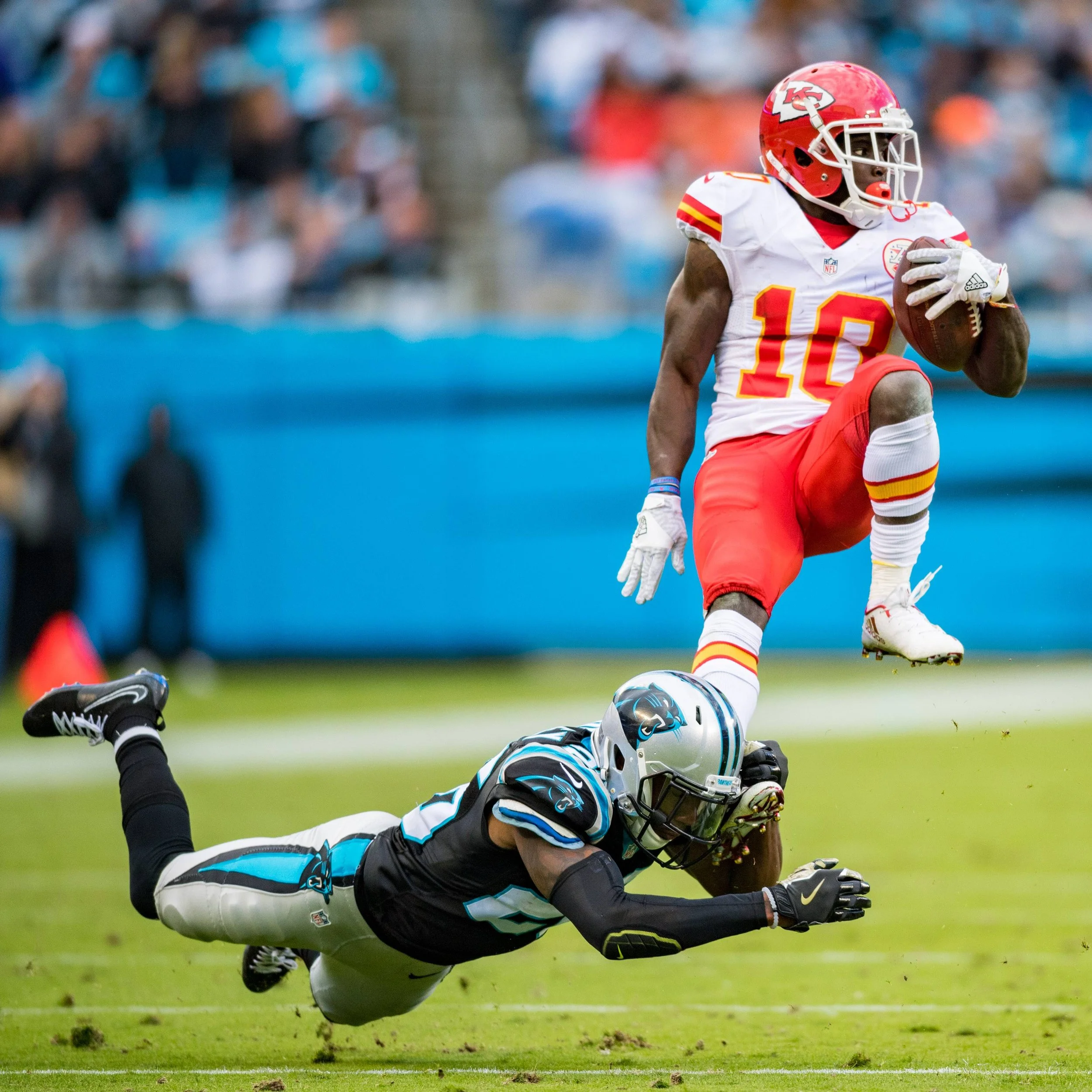
Carolina Panthers cornerback Daryl Worley (26) and Kansas City Chiefs wide receiver Tyreek Hill (10) during the NFL American Football Herren USA football game between the Kansas City Chiefs and the Carolina Panthers on Sunday, Nov 13, 2016 in Charlotte, NC. /CSM NFL 2016: Chiefs vs Panthers NOV 13 - ZUMAc04_ 20161113_zaf_c04_125 x0x 2016 quadrat premiumd
His route running improved significantly. Rather than relying exclusively on vertical routes, Hill became effective on curls, digs, crossing routes, slants and option concepts. Defenders who attempted to protect against the deep ball often found themselves vulnerable underneath. His acceleration out of breaks created separation in areas of the field where straight-line speed alone offered little advantage.
Equally important was his ability to track the football. Many receivers possess elite speed but struggle to locate and adjust to passes downfield. Hill consistently demonstrated the ability to maintain speed while tracking the ball over his shoulder, allowing him to convert deep targets into explosive gains. That skill transformed his athletic traits into tangible production.
Hill's development also revealed another important distinction between track speed and football speed. Track athletes run in predictable environments against competitors moving in the same direction. NFL receivers operate in constantly changing conditions. They must process coverage rotations, react to leverage, adjust to defensive techniques and maintain timing with the quarterback. Hill excelled in each of these areas, allowing his physical gifts to function within the structure of an NFL offense.
Perhaps the strongest evidence of Hill's complete skill set emerged following his trade to Miami in 2022. Critics questioned whether his production would decline outside of Kansas City's offensive system and without Mahomes at quarterback. Instead, Hill produced some of the most productive seasons of his career. The success demonstrated that his impact was not solely the product of circumstance. It was the result of a player whose understanding of the position had caught up with his rare athletic ability.
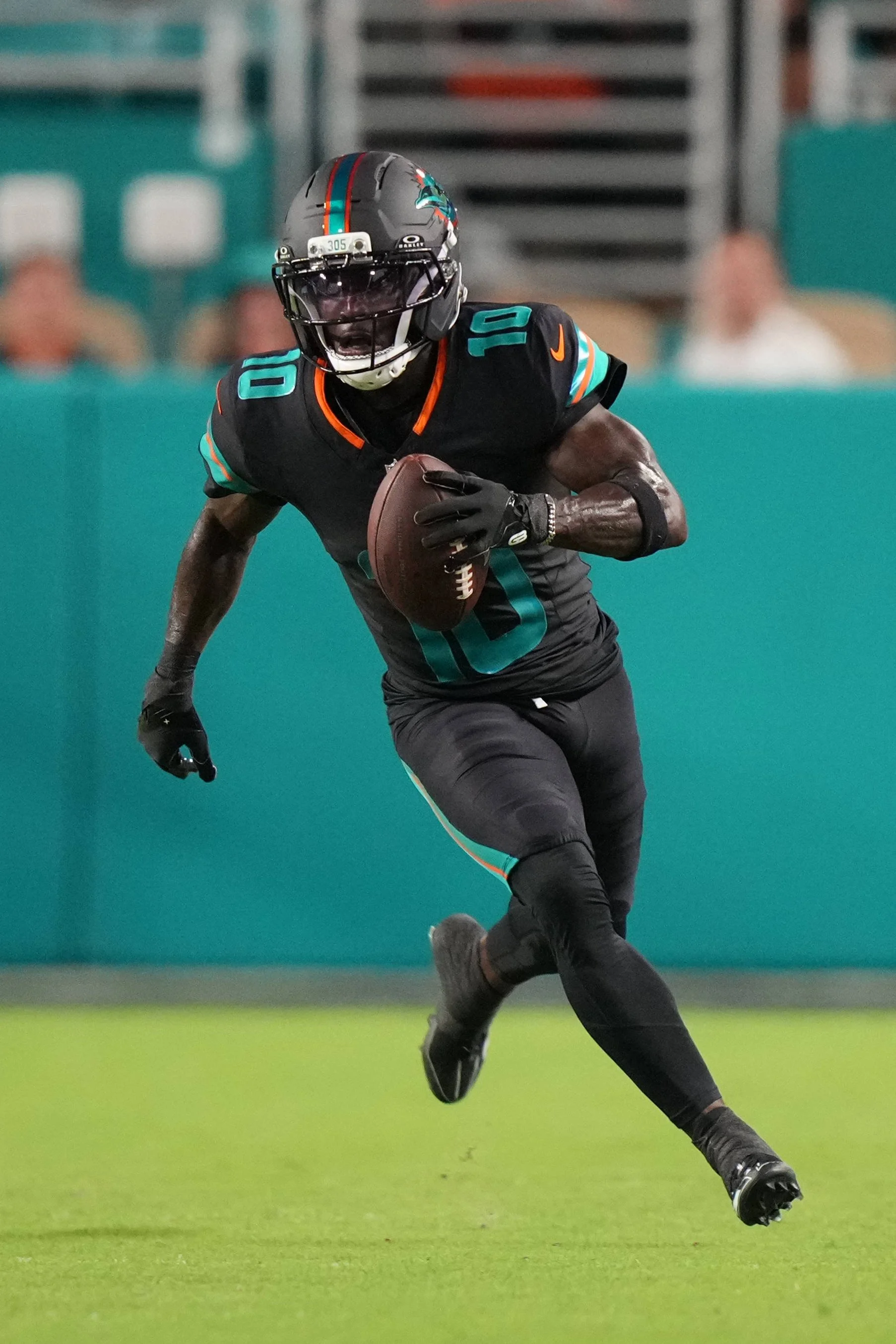
MIAMI GARDENS, FL - SEPTEMBER 29: Miami Dolphins wide receiver Tyreek Hill (10) runs after a catch during the game between the New York Jets and the Miami Dolphins on Monday, September 29, 2025 at Hard Rock Stadium in Miami, FL (Photo by Peter Joneleit/Icon Sportswire) NFL, American Football Herren, USA SEP 29 Jets at Dolphins
For NFL evaluators, Hill presents both a lesson and a temptation. The lesson is that speed can become a transformational trait when paired with technical refinement, football intelligence and consistent development. The temptation is believing that every elite athlete can follow the same path.
That belief continues to shape draft evaluations across the league. Every prospect who runs an exceptional 40-yard dash invites comparisons to Hill because teams are searching for the next player capable of changing defensive football. What often gets overlooked is that Hill's speed was only the beginning of the story. The qualities that transformed him into one of the most productive receivers of his generation were developed long after the stopwatch stopped.
Has the NFL Escaped “The Speed Trap?”
The NFL's fascination with speed is not going anywhere. If anything, the modern game places an even greater emphasis on explosive plays and offensive efficiency than it did a decade ago. What may be changing, however, is the way teams evaluate speed within the broader context of a prospect's profile.
Recent draft classes provide several examples.
When Xavier Worthy set a new NFL Combine record with a 4.21-second 40-yard dash in 2024, the performance generated immediate headlines. In previous eras, a time like that may have completely dominated discussions surrounding his evaluation. Instead, scouts continued to debate the same strengths and weaknesses that existed before the combine. His route running, frame, release package and ability to handle physical coverage remained central topics throughout the draft process.
A similar pattern emerged with Tyquan Thornton. Thornton's 4.28-second 40-yard dash placed him among the fastest prospects in recent memory, but evaluators remained divided on how his athletic traits would translate to the professional level. Questions surrounding his overall development as a receiver continued to accompany discussions about his speed.
The same dynamic has surrounded 2026 prospects such as Barion Brown. While elite athleticism remains one of the most attractive traits in scouting, teams have become increasingly cautious about allowing speed to serve as the defining characteristic of a player's evaluation. Instead, organizations place greater emphasis on how that speed manifests within the structure of the game.
The league's treatment of Tyreek Hill this offseason provides another example of how evaluations have evolved. A decade ago, a player with Hill's résumé might have generated a massive market based solely on name recognition and athletic reputation. Instead, teams have approached the situation cautiously, weighing his age, injury history and projected future performance against his past accomplishments. Even one of the most explosive players in NFL history is being evaluated through a broader lens than speed alone.
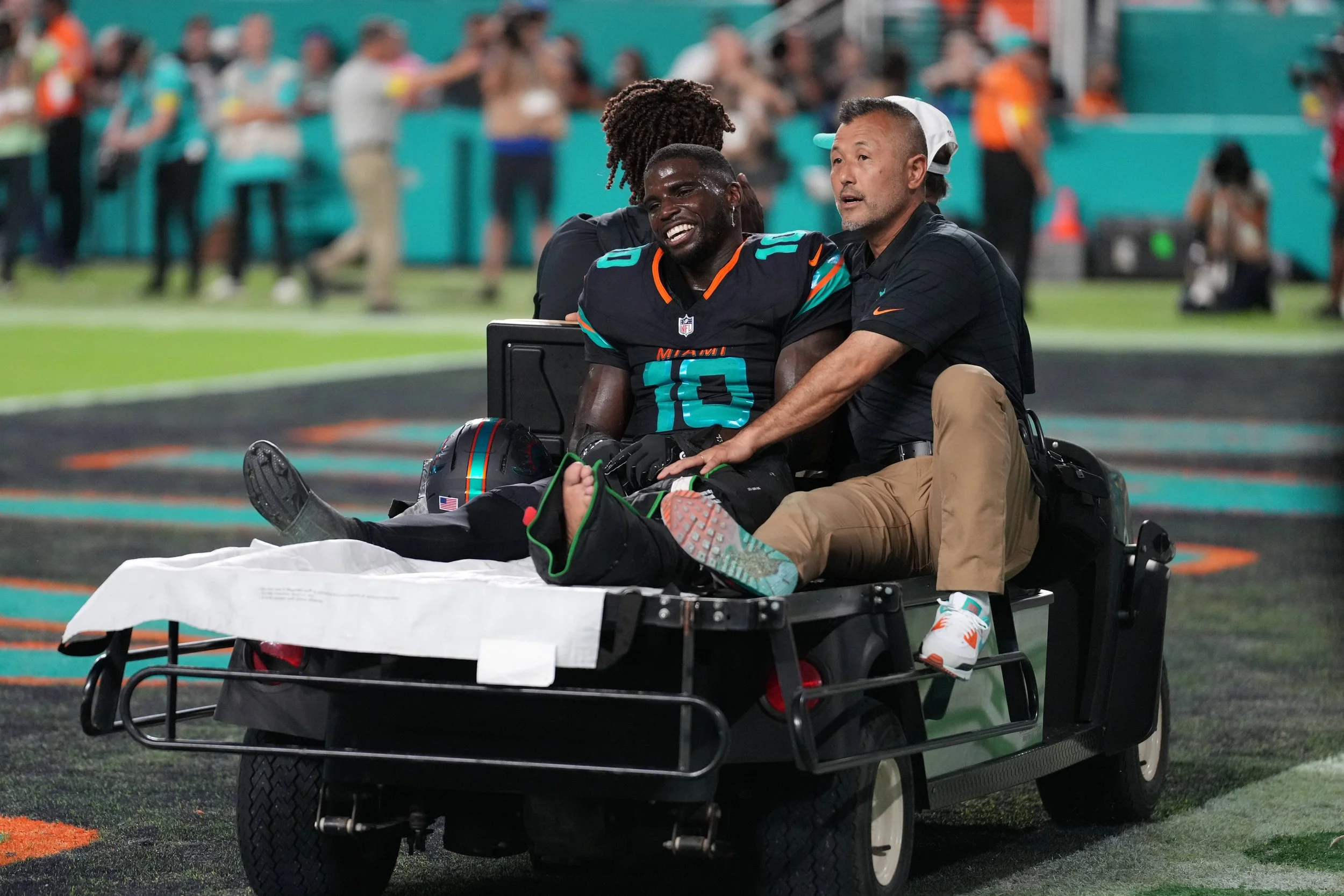
MIAMI GARDENS, FL - SEPTEMBER 29: Miami Dolphins wide receiver Tyreek Hill (10) leaves the field by cart after an injury during the game between the New York Jets and the Miami Dolphins on Monday, September 29, 2025 at Hard Rock Stadium in Miami, FL (Photo by Peter Joneleit/Icon Sportswire) NFL, American Football Herren, USA SEP 29 Jets at Dolphins
This shift reflects a broader change in NFL scouting. Modern evaluators have access to more information than ever before. GPS tracking data, advanced analytics and extensive film study allow teams to get a more well-rounded idea of players. The focus is no longer simply on how fast a player can run in a controlled environment.
The result is a draft process that appears more resistant to the type of dramatic projection that surrounded prospects such as John Ross. Elite speed can still elevate a player's draft stock, but it is increasingly viewed as one component of a larger evaluation rather than the evaluation itself.
That does not mean the NFL has solved the problem entirely. Every draft cycle still produces prospects whose athletic testing creates excitement and whose potential becomes the subject of endless discussion. The temptation to find the next Tyreek Hill remains as strong as ever. What has changed is that more teams appear willing to ask a critical question before making that comparison: what else does the player bring to the position?
That being said, the NFL is slowly but surely resisting their temptations and figuring out how not to be seduced by the clock and falling victim to The Speed Trap.
